 University of North Texas

Who We Are
The Division of Finance and Administration ensures UNT's physical and operational environment supports the success of students, faculty, and staff. Budget, Controller, Facilities, Police, Risk Management Services, and Transportation Services, as well as the Texas Municipal Clerks organization, are housed in this division. Safe, functional, and welcoming spaces at UNT Denton, Discovery Park, and Frisco are provided through 24-hour services, cultivation of strategic partnerships, and responsible stewardship of campus resources. These efforts enable the university community to pursue its educational and professional goals with confidence.
Our Strategic Goals (2026–2030)

Strengthen division capabilities and campus-wide effectiveness

Modernize infrastructure, technology, and operational systems
Expand student opportunity and strategic partnerships
Our Implementation Priorities
-
Strengthen training and career development division-wide: The division is reviewing policies and procedures campus-wide, expanding compliance training to UNT Bridge for asynchronous access, and building career development pathways that benefit both staff and students. Near-term milestones include Facilities outlining a journeyman licensure pathway and Police completing CALEA re-accreditation.
-
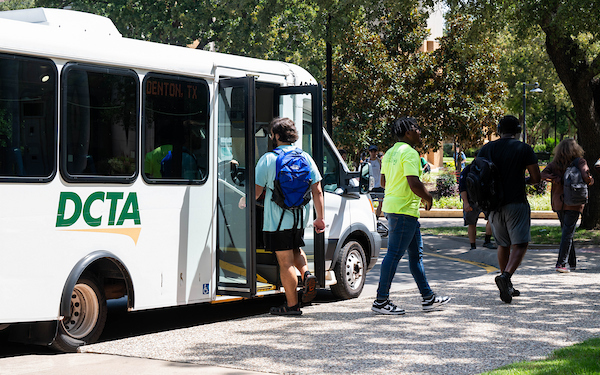
Expand student opportunities across all campuses: Finance and Administration is adding internships and career-aligned student roles wherever possible, including at Discovery Park and UNT Frisco, while improving tracking of student outcomes post-graduation. Transportation Services is exploring scholarship funding from citation revenue and new payment plan options to reduce financial barriers for students.
-
Leverage emerging technologies to drive efficiency and cost savings: The division is incorporating AI and machine learning into operations, with anticipated first-year savings of approximately $25,000 from Emergency Operations Center IT modernization and $150,000 from a new Facilities waste management process. Transportation Services is also exploring an autonomous vehicle feasibility study for campus transit.
-
Develop strategic partnerships for student and institutional impact: Finance and Administration will launch a new initiative, including dedicated staffing, to build relationships with businesses and organizations that create student opportunities and generate revenue or cost savings. Facilities, Transportation Services, and UNT Police are also contributing expertise to the UNT System Master Plan.
-
Support campus-wide implementation of UNT's strategic budgeting model: The Budget Office is expanding guidance resources, improving communication to ensure campus stakeholders understand their position under the new model, and exploring AI and machine learning applications to improve budgeting accuracy and reduce latency in financial reporting.
Core Metrics
UNT Baseline (2024/25): 77% | UNT Target (2030): 90%
Unit contribution to achieving targets:
- Facilities supports retention through space planning and classroom design. Division staff also teach in adjunct roles, providing students with applied professional learning opportunities.
UNT Baseline (2024/25): 42% | UNT Target (2030): 65%
Unit contribution to achieving targets:
- Facilities supports retention through space planning and classroom design. Division staff also teach in adjunct roles, providing students with applied professional learning opportunities.
UNT Baseline (2024/25): 61% | UNT Target (2030): 80%
Unit contribution to achieving targets:
- Facilities supports retention through space planning and classroom design. Division staff also teach in adjunct roles, providing students with applied professional learning opportunities.
UNT Baseline (2024/25): $124M | UNT Target (2030): $250M
Unit contribution to achieving targets:
- Division maintains subject matter experts for laboratory, research, and hazardous materials compliance. Risk Management provides risk financing strategies to protect critical research assets and limit financial and safety liabilities.
UNT Baseline (2024/25): 286 | UNT Target (2030): 300
Unit contribution to achieving targets:
- Indirect impact through supportive programming, resources, and processes.
UNT Baseline (2024/25): 6 years | UNT Target (2030): Decrease time for programs over median
Unit contribution to achieving targets:
- Indirect impact through supportive programming, resources, and processes.
Emergent Metrics
Important Dimensions of Our Success that Require New Approaches
Percentage of graduates placed in high-demand occupations or graduate and professional programs
Informal tracking already occurs in most units. Facilities has a model in place that can serve as a best practice for other units.
Percentage of academic programs that integrate internships, industry-sponsored projects, or other work-integrated learning experiences
Units offering student internships (Facilities, Police, Risk Management) track skills development and job placement. Units with student employees track training completions and work output. Division tracks participation in career fairs and university-sponsored events.
Prestigious awards, exhibitions, and performances achieved by our students, faculty, staff, and alumni
Internal division awards tracked formally; external awards tracked informally. Unit accreditations (Police, Transportation Services) are tracked, as well as professional certifications and licenses.
New ventures, startups, and public impact projects launched by students, faculty, and alumni
Division will begin tracking unit involvement in academic courses, including class projects that produce operational solutions. As public-private partnerships develop, outcome data will be tracked for projects expected to generate revenue or cost savings.
Perceptions of how well UNT prepares graduates to pursue lives of meaning and purpose
Division tracks social media analytics and engagement across campus audiences, alumni, and the local community. Units also track engagement at events such as tabling and citation forgiveness programs.
Unit Level Metrics
- Variance to budget (with explainer required for wide variance): Enables problem identification, diagnosis of cause and effect, and better understanding of variance drivers.
- Metrics needed for financial audits: Necessary for audit purposes; supports diagnosis of financial health and enables proper peer comparison.
- Compliance with police department accreditation standards: Required for continued accreditation of the unit.
- Investigation team case load and closure rates: Necessary for accountability.
- Patrol team calls, citation, and arrest rates: Necessary for accountability.
- Facilities condition index: Tracks deferred maintenance needs.
- Work order response time/completion rates: Supports continuous improvement of customer satisfaction.
- Utility cost per square foot: Monitors improvement needs and supports budget planning.
- Service delivery cost per square foot: Supports budget planning and identification of outsized building costs.
- Space utilization score: Required for state reporting.
- Training sessions completed/attendance: Measures compliance with training requirements.
- Number of workers’ comp/insurance claims: Identifies risk-prone areas and processes in need of improvement; informs budget planning.
- Safety inspection pass rates (food, fire, research labs): Ensures campus safety across facilities.
- Citations/permits issued: Tracks revenue, measures parking compliance, and informs strategic planning for campus growth.
- Sentiment analysis (through spot checks of customer interactions): Supports continuous improvement of customer service in Transportation Services.